
128k whitespace tokens, by accident: debugging the Responses API
View the series
- See how I used the OpenAI API to generate audio and images
- See why structured outputs also need hard guardrails
- Grab ready-to-use pytest snippets mocking the OpenAI API
- Add context to OpenAI API error messages for easier debugging
- Learn how to log OpenAI API calls in JSON format
- Learn how I parametrized tests and generated test data with GPT-5.2
- Cut down your Python import time with this 6-step method
Always set the
max_output_tokens
request parameter in the
OpenAI Responses API ↗. This is my new rule.
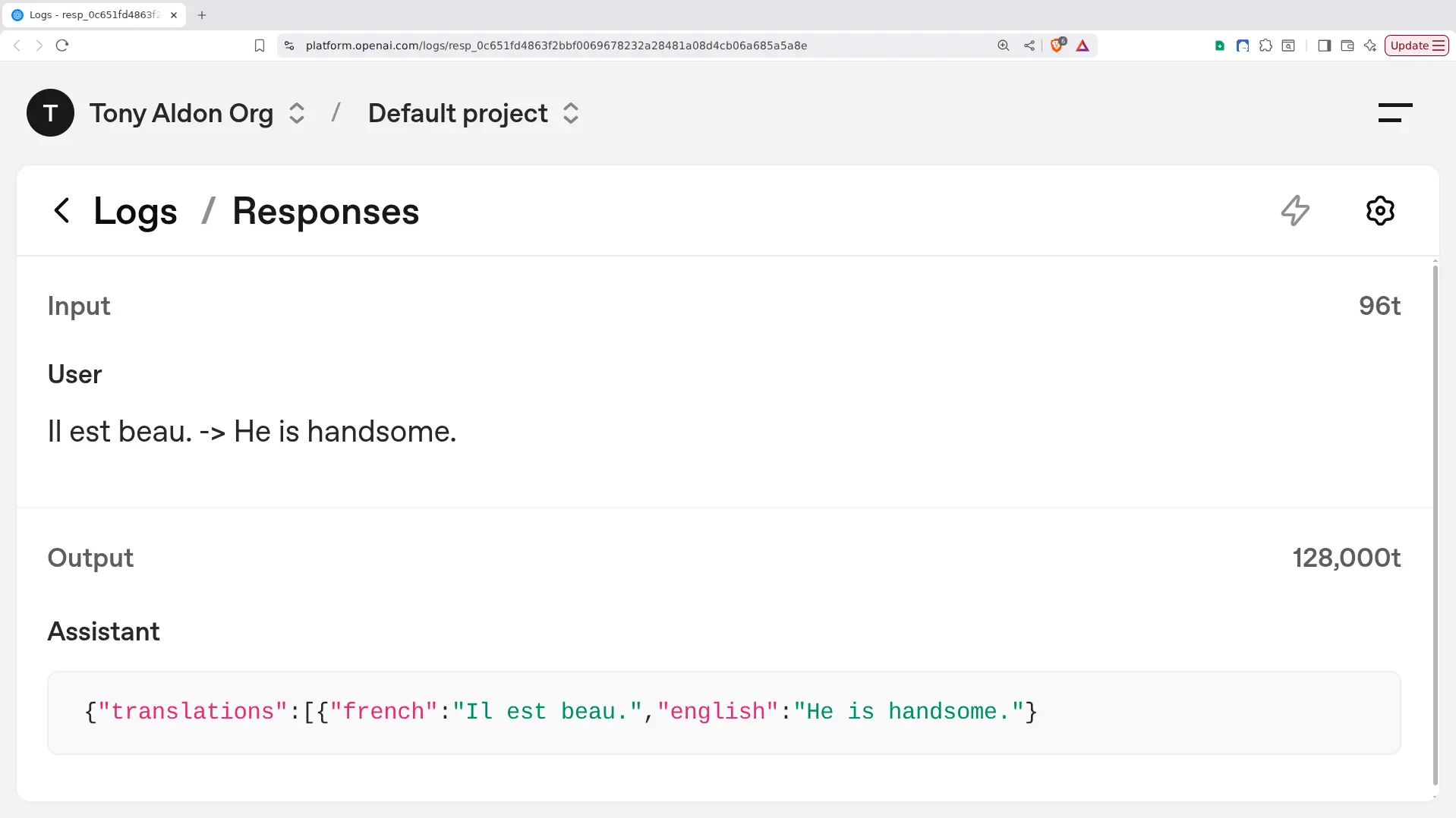
While testing phrasebook-fr-to-en CLI, for some reason the API generated 128k tokens, the maximum. I expected a JSON like this:
{
  "translations": [
    {
      "french": "fr2",
      "english": "en2"
    },
    {
      "french": "fr3",
      "english": "en3"
    }
  ]
}
I used their structured output ↗ feature and defined the expected JSON schema with this Pydantic ↗ model:
# DON'T USE THIS CODE.  IT MAKES THE REPSONSES API BUG.
from openai import OpenAI
from pydantic import BaseModel, conlist

client = OpenAI()

class Translation(BaseModel):
    french: str
    english: str

class Translations(BaseModel):
    # BUG CAUSED BY THIS FOLLOWING LINE
    translations: conlist(Translation, min_length=2, max_length=2)

response = client.responses.parse(
    model="gpt-5.2",
    input="Il est beau. -> He is handsome.",
    text_format=Translations,
)
But what I got was an incomplete JSON with more
than 63,000 whitespaces. In total, it hit exactly
128k tokens. If I had set the
max_output_tokens request
parameter to 256, it would have stopped at 256.
The bug seems to kick in because of the
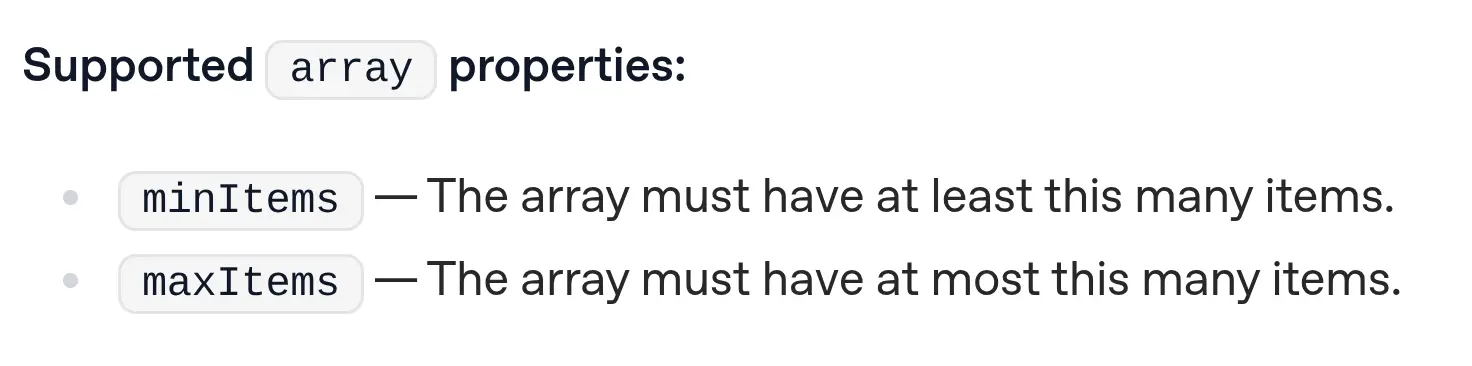
minItems and
maxItems array fields in the
JSON schema. I set both to 2 with
conlist(Translation, min_length=2, max_length=2)
in the Pydantic model. Per
the docs ↗
this should have worked:
And it did, once I removed the length condition on the array, the API responded the right way:
class Translations(BaseModel):
    translations: list[Translation]
Lesson learned:
Always set the
max_output_tokensrequest parameter in the OpenAI Responses API ↗.
No spam. Unsubscribe anytime.
That's all I have for today! Talk soon 👋